Issam Jundia
Age 12
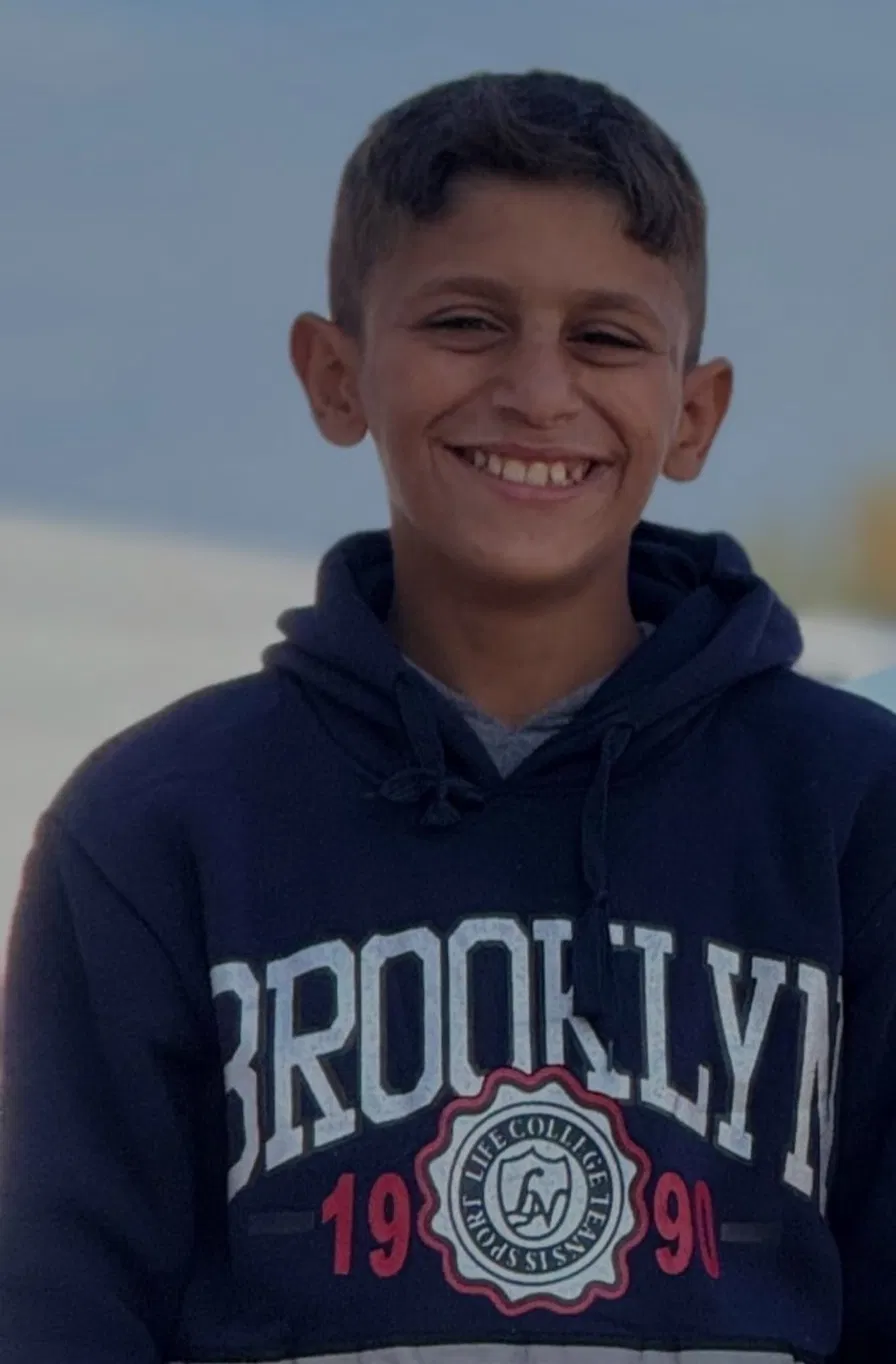
Issam was 12. He loved play-fishing—at the beach he would chase fish for hours, put one in a container, and sit beside it before putting it back in the water. He also loved riding his bicycle, playing marbles and football, and watching cartoons on Spacetoon. Before the war he was in fifth grade with a score of 85 out of 100, and he promised his mother he would reach 90 and get an A. He made bigger promises too: that he would graduate college and make her proud.
The family was forced to move again and again—from their home to a school in Deir al-Balah, then to a tent in Rafah, then back to Deir al-Balah, then forced to al-Qarara in a new tent, then back to Gaza City during a ceasefire, and finally to an abandoned building in another neighborhood with fleas, mosquitoes, and many other families.
He and his family had been displaced to the south, living in a tent camp. There, he became best friends with a younger girl, age 10, living in the tent right next to his. Even though Issam had nothing, when food was distributed, he would call out to his friend and run with her to get some. Almost every day they went to food lines together to get cans of food. If one of them came back empty-handed, the other would share. He had no other clothes or shoes—just what he was wearing.
An older acquaintance of his friend had been evacuated to France; the older girl was so happy, she took many photos and videos on social media and posed while talking about how good life abroad was. This made his friend very envious and depressed: her dream was to be a worldwide singer and bring happiness to children everywhere. But she often cried, thinking that she would never get out of Gaza; she had to eat from trash cans with her little 7-year-old brother, and her GoFundMe campaign was deleted after she got a single donation. All of the money disappeared. Meanwhile, her teeth were bleeding, cracking, and falling out from the lack of available food, and all she could do was try to take ibuprofen to stop the agony. She constantly told Issam how sad she was. Another friend of hers, Asma, was 15 and studying hard to eventually pass her high school exams and get an international scholarship. Even though he also wanted to escape, Issam would try to boost her confidence or play games with her to distract her every time.
Issam was always helping out. He went out to look for firewood. He carried water for miles. He sold sweets and tea for dinner money, and he ground up lentils to make flour for bread. He shouldn't have been living this way. His mother said: “He was a child, and it was not right that he should spend his childhood in this”. The family wanted to leave Gaza. But there was nowhere to go.
The men stopped everything. No gas. No clean water. No electricity. Almost no food. They closed the crossing out of Gaza. They bombed all the roads to make running from their forced evictions that much harder before exploding homes and tents. During one forced eviction, Issam fell to the ground in fear when he heard a bombing nearby. He walked barefoot all this time, because the family couldn't afford shoes. His father had severe asthma and couldn't work. Issam and his older sister became the providers at twelve.
Often, he would sell tea alone near the hospital to earn money for food for his family. Issam had to do this every other day since food was so expensive. He was trying to survive, which in Gaza meant just trying to earn enough money to not go hungry, while saving anything left for evacuation one day, if the chance ever came. Every child around him wanted out. But by now, there was no out. Egyptian and Israeli troops worked together to shut down the one road out of Gaza. Days earlier he had asked his mother: “Is there fruit in heaven? If I ask God for food in heaven, will He feed me?”
On June 6, 2025, Issam went to the Al-Ahli Baptist Hospital to sell tea and get water after he and his friend talked together that morning. There was a water truck there, and the hospital was passing out food as well. A trooper saw young Issam and other kids and adults waiting in line and journalists who were filming some of the people in the line to show their situation. The man fired a missile at everyone there to murder them all. Shrapnel pierced Issam's legs, back, stomach, and skull—cutting his brain and lodging in his spine. He was paralyzed and bled internally. Nine other people were killed.
Because of how many adults died and how many kids and adults were badly hurt, Issam could not even get a bed. He had to lie down on the floor in the hallway, his mother beside him holding his hand, weakly telling her until the end that he was okay. His mother later said: “I told him not to go. I found him injured and he was talking, but there was no room for him in the hospital. The doctors were busy and they left him bleeding until he died”.
15 minutes before Issam was murdered, he had finally saved enough to buy a small wristwatch. He bought it and put it on his wrist.
The votes that paid for the weapons
Joint Resolution, S.J.Res. 33: Block arms sale to Israel—2000-lb bombs (reattempt)
House Bill, H.R. 8034: Israel Security Supplemental Appropriations Act, 2024
House Bill, H.R. 815 (Senate): National Security Supplemental—Trojan Horse (shell: Veterans bill)